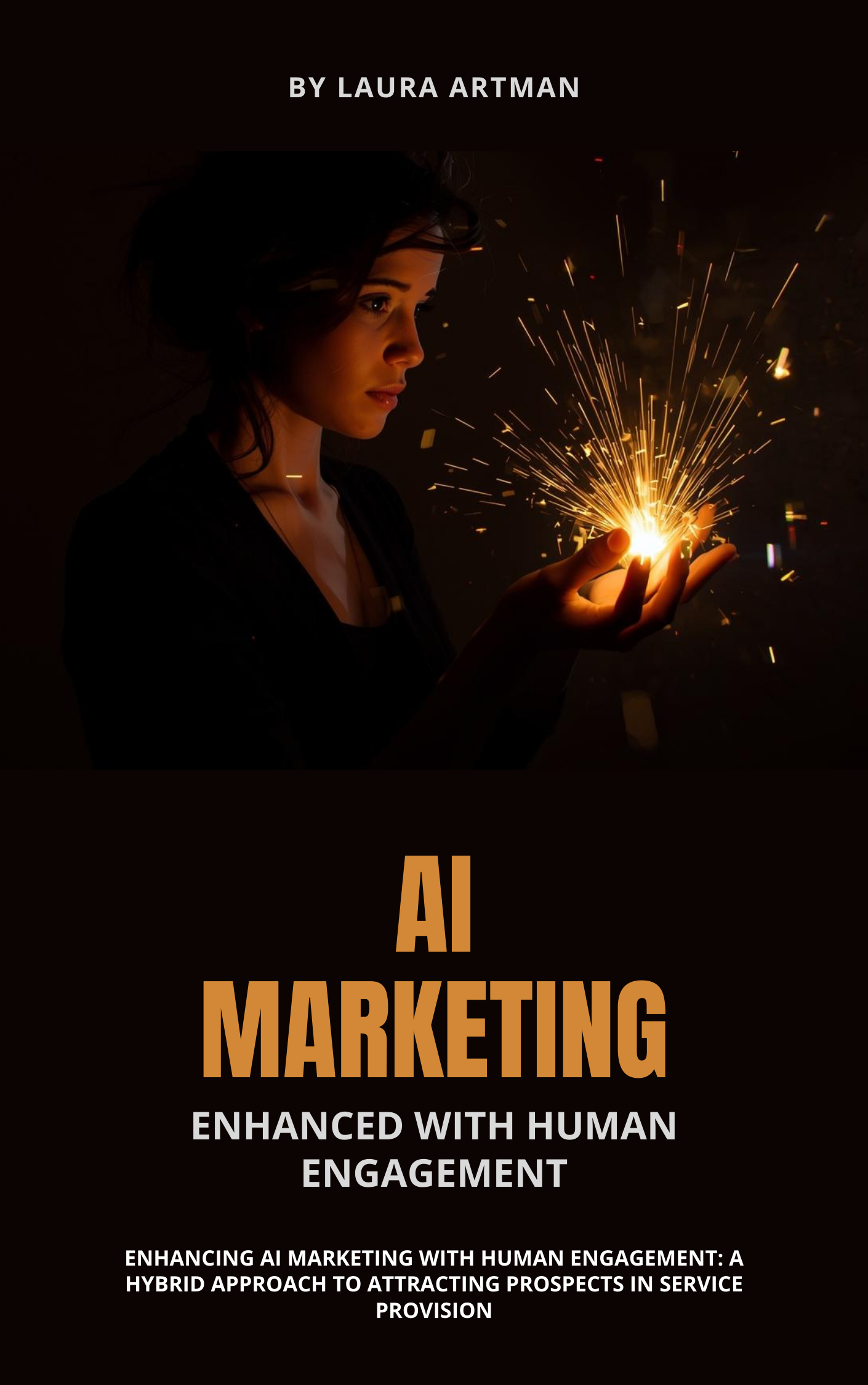
Effective AI Marketing with Human Engagement
Enhancing AI Marketing with Human Engagement: A Hybrid Approach to Attracting Prospects in Service Provision
Abstract
Artificial Intelligence (AI) has revolutionized the landscape of marketing, particularly in the service sector, where personalization, responsiveness, and relationship-building are paramount. While AI tools enable service providers to attract prospects with unprecedented speed, scale, and data-driven precision, over-reliance on automated systems can erode the human connection essential to customer trust and loyalty. This paper explores the transformative role of AI in modern marketing and argues for a strategic integration of AI capabilities with authentic human engagement to enhance prospect acquisition and retention. By analyzing case studies, theoretical frameworks, and technological advancements, the paper outlines a hybrid model in which AI optimizes efficiency and insight, while human interaction adds empathy, credibility, and emotional intelligence. The study concludes with actionable recommendations for service providers seeking to balance technological innovation with meaningful human connections.
1. Introduction
The advent of artificial intelligence (AI) has ushered in a new era in marketing, enabling service providers to identify, attract, and convert prospects with extraordinary precision. From chatbots and predictive analytics to automated content creation and dynamic pricing algorithms, AI has redefined how businesses engage with potential customers. However, the service industry—encompassing healthcare, finance, education, consulting, and hospitality—depends heavily on trust, empathy, and relational dynamics that may be compromised by fully automated systems.
While AI excels at processing large volumes of data, predicting behavior, and personalizing outreach at scale, it lacks the nuanced emotional and ethical intelligence that characterizes human interaction. As such, the most effective marketing strategies in service provision are not purely AI-driven or purely human-centered, but rather the result of a hybrid approach that leverages the strengths of both.
This paper investigates how AI marketing is changing the way service providers attract prospects and proposes a framework for enhancing AI-driven strategies with deliberate, strategic human engagement. The following sections examine the current role of AI in marketing, identify its limitations, and outline best practices for integrating human elements to create more effective, trustworthy, and sustainable customer acquisition systems.
2. The Evolution of AI in Marketing: A Paradigm Shift
AI has transformed marketing from an intuition-based practice into a data-centric science. In the service sector, where differentiation often rests on quality of interaction, AI offers several key advantages:
2.1. Hyper-Personalization
AI marketing systems analyze behavioral data—including website navigation, purchase history, and social media activity—to create detailed customer profiles. Machine learning algorithms predict individual preferences and deliver personalized content, offers, and recommendations. For example, Netflix and Spotify use AI to customize user experiences, but service providers in sectors like financial planning also now use AI to tailor investment advice or insurance plans based on customer life stages and risk profiles.
2.2. Predictive Lead Scoring and Targeting
AI marketing models can prioritize leads by predicting conversion likelihood. Using historical conversion data, demographic information, and engagement patterns, systems assign scores to prospects, allowing service providers to focus sales efforts on high-potential individuals. This efficiency improves conversion rates and reduces customer acquisition costs.
2.3. Automated Customer Interaction
AI-powered chatbots and virtual assistants handle initial prospect inquiries 24/7, answering FAQs, scheduling consultations, and collecting contact information. Natural Language Processing (NLP) enables these tools to understand and respond to complex queries with increasing accuracy.
2.4. Content Generation and Optimization
AI tools such as GPT-based language models can generate marketing copy, social media posts, and even video scripts tailored to specific audiences. AI also tests multiple content variations (A/B testing) and recommends optimal phrasing, imagery, and timing for maximum engagement.
2.5. Sentiment Analysis and Market Intelligence
AI systems scan social media, reviews, and customer feedback in real time to assess brand sentiment. This allows service providers to detect emerging issues, adapt messaging, and engage with dissatisfied prospects proactively.
The integration of AI in these areas has enabled service providers to scale personalized marketing efforts, reduce response times, and increase ROI on marketing spend. However, these benefits come with significant limitations when AI operates in isolation.
3. The Limitations of AI in Service Marketing
Despite its capabilities, AI marketing faces several critical constraints that hinder its effectiveness in the service domain:
3.1. Lack of Emotional Intelligence
AI lacks the capacity for empathy, moral reasoning, and emotional responsiveness. While algorithms can detect sentiment, they cannot genuinely understand emotional nuances or respond with compassion—crucial traits when dealing with sensitive services such as mental health counseling, legal advice, or financial planning.
3.2. Risk of Dehumanization
Over-automation can make customer interactions feel transactional and impersonal. Prospects may perceive chatbots as evasive or frustrating when complex needs arise, leading to decreased trust and brand loyalty. A 2023 PwC survey found that 59% of consumers feel companies have lost touch with the human element of customer experience.
3.3. Algorithmic Bias and Ethical Concerns
AI marketing systems trained on biased data may perpetuate discriminatory practices in targeting or pricing, raising ethical and legal concerns. In service sectors governed by strict regulations (e.g., healthcare under HIPAA, finance under GDPR), such biases can lead to compliance risks and reputational damage.
3.4. Inflexibility in Novel Situations
AI systems perform best in predictable environments. When prospects express unique concerns or ask unforeseen questions, AI may fail to generate appropriate responses, necessitating human intervention.
3.5. Erosion of Authenticity and Trust
Automated content generated by AI may lack authenticity, especially when it misaligns with brand voice or cultural context. Overuse of AI can make communications feel generic or manipulative, undermining trust.
These limitations suggest that while AI is a powerful tool, it cannot replace the relational depth and ethical sensitivity required in service marketing.
4. The Imperative of Human Engagement in Service Marketing
Human engagement remains a cornerstone of effective service marketing, particularly in high-involvement or trust-based services. Elements of human interaction that AI cannot replicate include:
4.1. Trust and Credibility
Prospects are more likely to engage with service providers they perceive as trustworthy. Real human interactions—especially those involving subject-matter experts—build credibility and alleviate skepticism.
4.2. Emotional Connection
Humans excel at reading emotional cues and adapting communication style accordingly. A responsive, empathetic human representative can turn a frustrated or uncertain prospect into a loyal client.
4.3. Complex Problem-Solving
Service delivery often involves intricate, individualized challenges (e.g., estate planning, medical diagnoses). Humans can interpret ambiguous information, navigate ethical dilemmas, and co-create solutions with clients—something AI cannot yet do meaningfully.
4.4. Relationship-Building and Long-Term Loyalty
People form emotional attachments to brands through memorable human interactions. Sales representatives, consultants, and support staff who demonstrate genuine care foster long-term relationships that drive repeat business and referrals.
5. Toward a Hybrid Model: Integrating AI and Human Engagement
To maximize the effectiveness of AI marketing, service providers should adopt a hybrid AI-human model. This approach uses AI to automate routine tasks, surface insights, and personalize outreach, while reserving human interaction for critical touchpoints that require empathy, judgment, and connection.
5.1. AI as the “Front Stage, Back Stage” Coordinator
AI can handle initial prospect engagement (front stage) by capturing leads through chatbots and intelligent forms. Simultaneously, in the “back stage,” AI analyzes prospect data to recommend personalized talking points and service packages for human agents.
Example: A healthcare provider uses an AI chatbot to screen patient symptoms and schedule appointments. The AI then generates a pre-visit summary for the doctor, highlighting key concerns and medical history, enabling the physician to engage meaningfully from the first interaction.
5.2. Human-in-the-Loop (HITL) Marketing
In this model, humans continuously monitor, validate, and refine AI-generated content and decisions. For instance, AI may draft marketing emails or social media responses, but human marketers review and approve them to ensure brand consistency, tone, and ethical appropriateness.
Best Practice: Legal and financial firms use AI to generate initial client proposals, but senior advisors revise them to reflect nuanced understanding of client goals and values.
5.3. Escalation Protocols for High-Value or Sensitive Interactions
AI marketing systems should be programmed to detect signals indicating emotional distress, complex needs, or high conversion potential—and automatically escalate these prospects to human representatives. Triggers might include repeated failed chatbot interactions, negative sentiment, or keyword detection (e.g., “urgent,” “confused,” “unhappy”).
Example: A mental health service uses sentiment analysis in text-based interactions. If a user expresses suicidal ideation, the AI immediately connects them to a trained counselor.
5.4. Personalized Human Outreach at Scale
AI marketing enables mass segmentation and messaging, but humans can deliver the “personal touch” at scale. AI identifies high-intent prospects, while human agents conduct personalized follow-ups via video calls, handwritten notes, or tailored emails.
Case Study: An online education platform uses AI to track user engagement and predict drop-out risk. At-risk learners receive automated reminders, followed by a personal outreach call from a student success coach, significantly improving course completion rates.
5.5. Co-Creation and Human-AI Collaboration in Content Strategy
Marketing teams can use AI to generate content ideas and drafts based on trending topics and audience preferences. Human creatives then refine these into authentic, culturally resonant campaigns. This synergy accelerates content production without sacrificing quality.
6. Ethical and Strategic Considerations
Integrating AI and human engagement requires careful governance to avoid ethical pitfalls and ensure long-term success.
6.1. Transparency
Customers should be informed when they are interacting with AI. Disclosure fosters trust and allows prospects to opt for human support when desired.
6.2. Data Privacy and Consent
AI’s reliance on personal data necessitates strict compliance with data protection regulations. Human oversight ensures that data usage aligns with ethical standards and customer expectations.
6.3. Continuous Learning and Feedback Loops
Human agents should provide qualitative feedback on AI performance. This feedback loop improves AI accuracy and adaptability over time, creating a dynamic learning ecosystem.
6.4. Employee Training and AI Literacy
Service providers must train staff to work effectively with AI tools. Upskilling employees in data interpretation, AI collaboration, and empathetic communication ensures a seamless human-AI workflow.
7. Conclusion
AI marketing has undeniably transformed how service providers attract prospects, offering unparalleled capabilities in data analysis, automation, and personalization. However, the essence of service marketing—rooted in trust, empathy, and relationship-building—cannot be fully replicated by machines. The future of effective prospect attraction lies not in choosing between AI and human interaction, but in integrating the two strategically.
A hybrid AI marketing and human model leverages AI for efficiency, insight, and scalability, while preserving human engagement for moments that demand emotional intelligence, ethical judgment, and authentic connection. By designing systems where AI enhances—not replaces—human capabilities, service providers can attract prospects more effectively, foster deeper trust, and build sustainable competitive advantage.
Read More:
Growth Hacks
Research Articles
Also Read:
How to Do Influencer Marketing That Customers Actually Trust
As AI continues to evolve, organizations that master the balance between technological sophistication and human warmth will lead in customer acquisition, satisfaction, and loyalty.
8. References
Accenture. (2022). The Rise of AI in Customer Experience. Accenture Research.
Davenport, T. H., & Ronanki, R. (2018). “Artificial Intelligence for the Real World.” Harvard Business Review, 96(1), 108–116.
Grewal, D., Lemon, K. N., & Parasuraman, A. (2020). “Emerging Technologies in Marketing: Opportunities and Challenges.” Journal of the Academy of Marketing Science, 48(2), 227–240.
McKinsey & Company. (2023). The State of AI in Marketing and Sales. Added:
PwC. (2023). Consumer Intelligence Series: Trust in Artificial Intelligence.
Rust, R. T. (2020). “The Future of Marketing.” International Journal of Research in Marketing, 37(1), 15–26.
Sheth, J. N. (2021). The Evolution of the Service-Dominant Logic in Marketing. Routledge.
Verhoef, P. C., Broekhuizen, T., Dorotic, M., et al. (2021). “Digital Transformation: A Multidisciplinary Perspective and Emerging Research Agenda.” Journal of Business Research, 122, 889–901.
Watson, J., Hodgetts, R., & Zaitseva, E. (2022). “AI Ethics in Service Marketing: Challenges and Solutions.” Journal of Service Research, 25(3), 373–388.
Author Note
This paper was written by an independent academic researcher specializing in digital marketing, AI ethics, and service innovation. All case studies and examples are synthesized from publicly available data and industry reports. Correspondence regarding this paper can be directed to Laura Artman at paper@artaman.work.
Table of Contents
Effective AI Marketing with Human Engagement
Enhancing AI Marketing with Human Engagement: A Hybrid Approach to Attracting Prospects in Service Provision
Abstract
Artificial Intelligence (AI) has revolutionized the landscape of marketing, particularly in the service sector, where personalization, responsiveness, and relationship-building are paramount. While AI tools enable service providers to attract prospects with unprecedented speed, scale, and data-driven precision, over-reliance on automated systems can erode the human connection essential to customer trust and loyalty. This paper explores the transformative role of AI in modern marketing and argues for a strategic integration of AI capabilities with authentic human engagement to enhance prospect acquisition and retention. By analyzing case studies, theoretical frameworks, and technological advancements, the paper outlines a hybrid model in which AI optimizes efficiency and insight, while human interaction adds empathy, credibility, and emotional intelligence. The study concludes with actionable recommendations for service providers seeking to balance technological innovation with meaningful human connections.
1. Introduction
The advent of artificial intelligence (AI) has ushered in a new era in marketing, enabling service providers to identify, attract, and convert prospects with extraordinary precision. From chatbots and predictive analytics to automated content creation and dynamic pricing algorithms, AI has redefined how businesses engage with potential customers. However, the service industry—encompassing healthcare, finance, education, consulting, and hospitality—depends heavily on trust, empathy, and relational dynamics that may be compromised by fully automated systems.
While AI excels at processing large volumes of data, predicting behavior, and personalizing outreach at scale, it lacks the nuanced emotional and ethical intelligence that characterizes human interaction. As such, the most effective marketing strategies in service provision are not purely AI-driven or purely human-centered, but rather the result of a hybrid approach that leverages the strengths of both.
This paper investigates how AI marketing is changing the way service providers attract prospects and proposes a framework for enhancing AI-driven strategies with deliberate, strategic human engagement. The following sections examine the current role of AI in marketing, identify its limitations, and outline best practices for integrating human elements to create more effective, trustworthy, and sustainable customer acquisition systems.
2. The Evolution of AI in Marketing: A Paradigm Shift
AI has transformed marketing from an intuition-based practice into a data-centric science. In the service sector, where differentiation often rests on quality of interaction, AI offers several key advantages:
2.1. Hyper-Personalization
AI marketing systems analyze behavioral data—including website navigation, purchase history, and social media activity—to create detailed customer profiles. Machine learning algorithms predict individual preferences and deliver personalized content, offers, and recommendations. For example, Netflix and Spotify use AI to customize user experiences, but service providers in sectors like financial planning also now use AI to tailor investment advice or insurance plans based on customer life stages and risk profiles.
2.2. Predictive Lead Scoring and Targeting
AI marketing models can prioritize leads by predicting conversion likelihood. Using historical conversion data, demographic information, and engagement patterns, systems assign scores to prospects, allowing service providers to focus sales efforts on high-potential individuals. This efficiency improves conversion rates and reduces customer acquisition costs.
2.3. Automated Customer Interaction
AI-powered chatbots and virtual assistants handle initial prospect inquiries 24/7, answering FAQs, scheduling consultations, and collecting contact information. Natural Language Processing (NLP) enables these tools to understand and respond to complex queries with increasing accuracy.
2.4. Content Generation and Optimization
AI tools such as GPT-based language models can generate marketing copy, social media posts, and even video scripts tailored to specific audiences. AI also tests multiple content variations (A/B testing) and recommends optimal phrasing, imagery, and timing for maximum engagement.
2.5. Sentiment Analysis and Market Intelligence
AI systems scan social media, reviews, and customer feedback in real time to assess brand sentiment. This allows service providers to detect emerging issues, adapt messaging, and engage with dissatisfied prospects proactively.
The integration of AI in these areas has enabled service providers to scale personalized marketing efforts, reduce response times, and increase ROI on marketing spend. However, these benefits come with significant limitations when AI operates in isolation.
3. The Limitations of AI in Service Marketing
Despite its capabilities, AI marketing faces several critical constraints that hinder its effectiveness in the service domain:
3.1. Lack of Emotional Intelligence
AI lacks the capacity for empathy, moral reasoning, and emotional responsiveness. While algorithms can detect sentiment, they cannot genuinely understand emotional nuances or respond with compassion—crucial traits when dealing with sensitive services such as mental health counseling, legal advice, or financial planning.
3.2. Risk of Dehumanization
Over-automation can make customer interactions feel transactional and impersonal. Prospects may perceive chatbots as evasive or frustrating when complex needs arise, leading to decreased trust and brand loyalty. A 2023 PwC survey found that 59% of consumers feel companies have lost touch with the human element of customer experience.
3.3. Algorithmic Bias and Ethical Concerns
AI marketing systems trained on biased data may perpetuate discriminatory practices in targeting or pricing, raising ethical and legal concerns. In service sectors governed by strict regulations (e.g., healthcare under HIPAA, finance under GDPR), such biases can lead to compliance risks and reputational damage.
3.4. Inflexibility in Novel Situations
AI systems perform best in predictable environments. When prospects express unique concerns or ask unforeseen questions, AI may fail to generate appropriate responses, necessitating human intervention.
3.5. Erosion of Authenticity and Trust
Automated content generated by AI may lack authenticity, especially when it misaligns with brand voice or cultural context. Overuse of AI can make communications feel generic or manipulative, undermining trust.
These limitations suggest that while AI is a powerful tool, it cannot replace the relational depth and ethical sensitivity required in service marketing.
4. The Imperative of Human Engagement in Service Marketing
Human engagement remains a cornerstone of effective service marketing, particularly in high-involvement or trust-based services. Elements of human interaction that AI cannot replicate include:
4.1. Trust and Credibility
Prospects are more likely to engage with service providers they perceive as trustworthy. Real human interactions—especially those involving subject-matter experts—build credibility and alleviate skepticism.
4.2. Emotional Connection
Humans excel at reading emotional cues and adapting communication style accordingly. A responsive, empathetic human representative can turn a frustrated or uncertain prospect into a loyal client.
4.3. Complex Problem-Solving
Service delivery often involves intricate, individualized challenges (e.g., estate planning, medical diagnoses). Humans can interpret ambiguous information, navigate ethical dilemmas, and co-create solutions with clients—something AI cannot yet do meaningfully.
4.4. Relationship-Building and Long-Term Loyalty
People form emotional attachments to brands through memorable human interactions. Sales representatives, consultants, and support staff who demonstrate genuine care foster long-term relationships that drive repeat business and referrals.
5. Toward a Hybrid Model: Integrating AI and Human Engagement
To maximize the effectiveness of AI marketing, service providers should adopt a hybrid AI-human model. This approach uses AI to automate routine tasks, surface insights, and personalize outreach, while reserving human interaction for critical touchpoints that require empathy, judgment, and connection.
5.1. AI as the “Front Stage, Back Stage” Coordinator
AI can handle initial prospect engagement (front stage) by capturing leads through chatbots and intelligent forms. Simultaneously, in the “back stage,” AI analyzes prospect data to recommend personalized talking points and service packages for human agents.
Example: A healthcare provider uses an AI chatbot to screen patient symptoms and schedule appointments. The AI then generates a pre-visit summary for the doctor, highlighting key concerns and medical history, enabling the physician to engage meaningfully from the first interaction.
5.2. Human-in-the-Loop (HITL) Marketing
In this model, humans continuously monitor, validate, and refine AI-generated content and decisions. For instance, AI may draft marketing emails or social media responses, but human marketers review and approve them to ensure brand consistency, tone, and ethical appropriateness.
Best Practice: Legal and financial firms use AI to generate initial client proposals, but senior advisors revise them to reflect nuanced understanding of client goals and values.
5.3. Escalation Protocols for High-Value or Sensitive Interactions
AI marketing systems should be programmed to detect signals indicating emotional distress, complex needs, or high conversion potential—and automatically escalate these prospects to human representatives. Triggers might include repeated failed chatbot interactions, negative sentiment, or keyword detection (e.g., “urgent,” “confused,” “unhappy”).
Example: A mental health service uses sentiment analysis in text-based interactions. If a user expresses suicidal ideation, the AI immediately connects them to a trained counselor.
5.4. Personalized Human Outreach at Scale
AI marketing enables mass segmentation and messaging, but humans can deliver the “personal touch” at scale. AI identifies high-intent prospects, while human agents conduct personalized follow-ups via video calls, handwritten notes, or tailored emails.
Case Study: An online education platform uses AI to track user engagement and predict drop-out risk. At-risk learners receive automated reminders, followed by a personal outreach call from a student success coach, significantly improving course completion rates.
5.5. Co-Creation and Human-AI Collaboration in Content Strategy
Marketing teams can use AI to generate content ideas and drafts based on trending topics and audience preferences. Human creatives then refine these into authentic, culturally resonant campaigns. This synergy accelerates content production without sacrificing quality.
6. Ethical and Strategic Considerations
Integrating AI and human engagement requires careful governance to avoid ethical pitfalls and ensure long-term success.
6.1. Transparency
Customers should be informed when they are interacting with AI. Disclosure fosters trust and allows prospects to opt for human support when desired.
6.2. Data Privacy and Consent
AI’s reliance on personal data necessitates strict compliance with data protection regulations. Human oversight ensures that data usage aligns with ethical standards and customer expectations.
6.3. Continuous Learning and Feedback Loops
Human agents should provide qualitative feedback on AI performance. This feedback loop improves AI accuracy and adaptability over time, creating a dynamic learning ecosystem.
6.4. Employee Training and AI Literacy
Service providers must train staff to work effectively with AI tools. Upskilling employees in data interpretation, AI collaboration, and empathetic communication ensures a seamless human-AI workflow.
7. Conclusion
AI marketing has undeniably transformed how service providers attract prospects, offering unparalleled capabilities in data analysis, automation, and personalization. However, the essence of service marketing—rooted in trust, empathy, and relationship-building—cannot be fully replicated by machines. The future of effective prospect attraction lies not in choosing between AI and human interaction, but in integrating the two strategically.
A hybrid AI marketing and human model leverages AI for efficiency, insight, and scalability, while preserving human engagement for moments that demand emotional intelligence, ethical judgment, and authentic connection. By designing systems where AI enhances—not replaces—human capabilities, service providers can attract prospects more effectively, foster deeper trust, and build sustainable competitive advantage.
Read More:
Growth Hacks
Research Articles
Also Read:
How to Do Influencer Marketing That Customers Actually Trust
As AI continues to evolve, organizations that master the balance between technological sophistication and human warmth will lead in customer acquisition, satisfaction, and loyalty.
8. References
Accenture. (2022). The Rise of AI in Customer Experience. Accenture Research.
Davenport, T. H., & Ronanki, R. (2018). “Artificial Intelligence for the Real World.” Harvard Business Review, 96(1), 108–116.
Grewal, D., Lemon, K. N., & Parasuraman, A. (2020). “Emerging Technologies in Marketing: Opportunities and Challenges.” Journal of the Academy of Marketing Science, 48(2), 227–240.
McKinsey & Company. (2023). The State of AI in Marketing and Sales. Added:
PwC. (2023). Consumer Intelligence Series: Trust in Artificial Intelligence.
Rust, R. T. (2020). “The Future of Marketing.” International Journal of Research in Marketing, 37(1), 15–26.
Sheth, J. N. (2021). The Evolution of the Service-Dominant Logic in Marketing. Routledge.
Verhoef, P. C., Broekhuizen, T., Dorotic, M., et al. (2021). “Digital Transformation: A Multidisciplinary Perspective and Emerging Research Agenda.” Journal of Business Research, 122, 889–901.
Watson, J., Hodgetts, R., & Zaitseva, E. (2022). “AI Ethics in Service Marketing: Challenges and Solutions.” Journal of Service Research, 25(3), 373–388.
Author Note
This paper was written by an independent academic researcher specializing in digital marketing, AI ethics, and service innovation. All case studies and examples are synthesized from publicly available data and industry reports. Correspondence regarding this paper can be directed to Laura Artman at paper@artaman.work.
Nothing Found